- Home
- Intelligence
The Meaning of Intelligence
The meaning of intelligence is that it is an essential aspect of life required for the creation of meaning itself.
Intelligence is closely related to consciousness. In fact, intelligence is the power of consciousness to know, to experience and to create.
There are different kinds of intelligence, described below.
In humans, intelligence can be cultivated to enhance the meaning of life.
Definition of intelligence
 Rat finds the cheese!
ID 2307168 © Juan Manuel Ordonez | Dreamstime.com
Rat finds the cheese!
ID 2307168 © Juan Manuel Ordonez | Dreamstime.comIntelligence is required to fulfil the purpose of life. It is the guiding principle behind successful behaviour. This is the real meaning of intelligence.
All living things behave and behaviour always has a purpose. The purpose can range from the securing of the necessities of life such as food, water, safety and mating rights, to action which maintains individual and collective health.
Human behaviour includes these basic activities alongside action to meet more sophisticated human agendas such as the successful completion of an exam, the design and execution of a research program, the planning and building of a cathedral, the conduct of a war, the management of society, the creation of world peace.
Behaviour always takes place in an environment, complete with other life forms also behaving to fulfil their own needs and purposes. Consequently, behaviour needs to be adaptive to changing circumstances if it is to be successful. This is the function and meaning of individual intelligence, to work with instinct, experience, memory and knowledge to create the conditions in daily life for success.
Any entity can be described as “intelligent” if it displays intelligent behaviour without external control. “Intelligence” is therefore a quality that is inferred from observation of behaviour, it is not directly seen.
The meaning of intelligence is given in the statement that Intelligent behaviour is goal-oriented activity which is adaptive to circumstance. The greater the degree of intelligence, the greater the chances of successful behaviour in a changing world.
Consequently, intelligence is often associated with the ability to solve problems and can be natural (for an organism) or artificial (for a machine).
Existence and the meaning of Intelligence
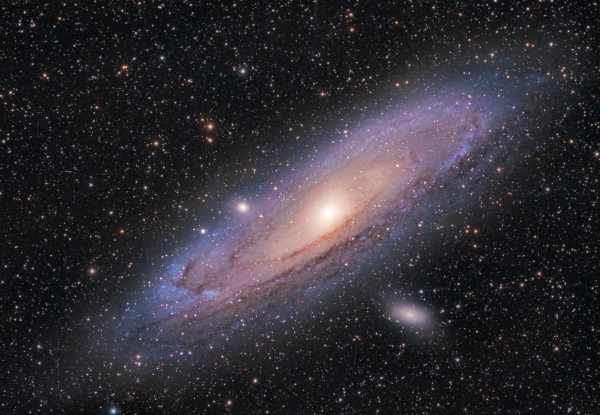 Andromeda Galaxy and stars
ID 74665459 © passmil198216 | Adobe.com
Andromeda Galaxy and stars
ID 74665459 © passmil198216 | Adobe.comIt is a self-evident fact that the universe exists. We can therefore conceive of a state of pure existence or Being – an abstract and absolute state of existence that underpins all specific aspects of existence.
It is also obvious that there is order in both the existence and activity of the universe. Modern Science describes this orderliness in terms of symmetry and the laws of nature. The ancient Vedic Seers described it in terms of cosmic intelligence. Therefore, intelligence is a natural property of existence related to symmetry, orderliness and its expression in the way the universe works.
Intelligence gives the world meaning on many levels.
Intelligence is cosmic if we are considering the orderliness of the universe as a whole and individual if we are considering the orderliness of the behaviour of specific individual forms of life. The full meaning of intelligence takes the relationship between the cosmic value and the individual value into account.
Cosmic Intelligence operates to create, maintain and evolve a whole diverse range of individual life forms as a natural manifestation of the unified wholeness of cosmic existence or Being. In this process of manifestation, a variety of shared worlds are created, each populated by specific sets of individual life forms which inevitably interact.
Each form and each individual representation of the form has its own specific set of purposes and its own individual value of intelligence. Individuals, expressing existence through their own specific forms are bound to behave according to their own life purposes aided by their own values of intelligence. Cosmic intelligence, managing existence as a whole, expresses itself through the laws of nature, governing the modes and consequences of individual actions.
Life is naturally intelligent
 Dandelion seeds blowing in the wind
ID 14524298 © Maram | Dreamstime.com
Dandelion seeds blowing in the wind
ID 14524298 © Maram | Dreamstime.com
Maharishi defined life in its most general terms as “the expression of Divinity” and he defined the purpose of life as “the expansion of happiness”.
Like Being, life has both a relative and absolute phase.
As described above, the relative or phenomenal phase of life is expressed through the activity of a vast diversity of interacting and inter-connected individual life forms. This vast range of inter-dependent relative expression is, however, based on an absolute and eternal phase of pure existence which is transcendental in nature. If that were not the case, life would be chaotic, baseless, unstable and without a purpose.
Intelligence has meaning for both the relative and absolute phases of Being.
Maharishi has explained that Being in itself is neither transcendental nor relative, it just is. The ultimate understanding about Being is that it is the unified wholeness of all existence – all the parts functioning coherently together in the context of the whole. It might be thought that when the active phase of relative existence appears, then the unmanifest state of pure existence, the absolute phase of Being must disappear, since it is logical to think that either something exists or nothing exists, not both together. Yet, the individual aspects of life function together as a unified whole, showing that there is something intangible that exists that is more than the simple sum of all the existing parts.
When life in all its individual variety appears, its basis, the unified wholeness of all existence, does not disappear. It assumes a transcendental role, underpinning the constantly changing manifest world with an eternally non-changing stable basis, silently hiding, but still existing, deep within the field of change. Hence life, just as for Being, can be considered to have two apparently unconnected phases – manifest and unmanifest, relative and absolute, phenomenal and transcendental.
This appearance is, however, deceptive and hides the ultimate truth as described by the vedic sages, that both phases of Being, both phases of life, are united in the single Being of almighty God, who presides over both the absolute and the relative, holding them together as one in the eternity of His own Divine Being. This is a religious description of the unified wholeness of all existence.
The full meaning of intelligence is that it is Divine in nature.
Intelligence, law and evolution
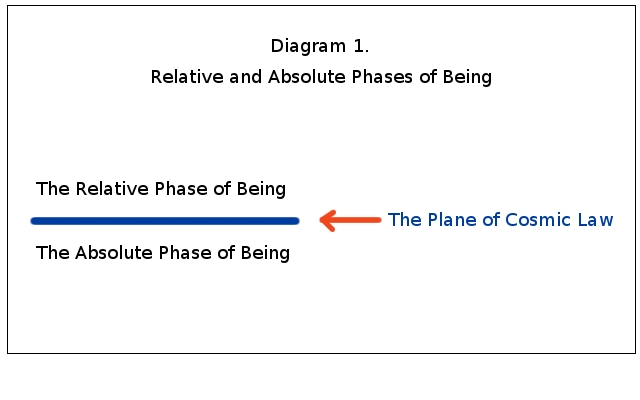 Diagram showing the phases of Being and the Plane of Cosmic Law
It is helpful to think that there is a Divine junction point or plane existing between the absolute and relative phases of life which acts as the eternal well-spring, the source from which all the relative streams of life emerge and develop. Cosmic intelligence, described in religious terms as the will of God, operates from within this junction point or plane, constantly creating, maintaining, evolving and dissolving the entire universe and all that it contains. Here is found both the religious and the philosophical meaning of intelligence.
Describing this region as a plane, separating the absolute and relative phases of Being, Maharishi called it “the plane of Cosmic Law” and “the home of all the laws of nature”.
Individual life is projected from its source in Being via the laws of nature acting from the plane of Cosmic law and finds its fulfillment through the process of evolution (which is both personal and biological). Evolution allows individual life to move in steps of experience towards the blissful nectar of Divine Union with its creator, God.
Life therefore has a source, a course and a goal.
Since life has a goal and since life is expressed in multiple interacting life-forms, all acting simultaneously to satisfy their own life purposes, then all life is naturally intelligent. All the life forms, including all their respective modes of behaviour as well as the outcomes and consequences of behaviour, are governed by natural law. This is an ancient knowledge which has in more recent times, morphed on the one hand into scientific descriptions of the laws of nature and on the other into ethical and moral descriptions of the rights of the individual.
Consciousness and the meaning of intelligence
 Huge star burst and heavenly celestial clouds
ID 188753051 © Nikki Zalewski | Dreamstime.com
Huge star burst and heavenly celestial clouds
ID 188753051 © Nikki Zalewski | Dreamstime.comConsciousness is essential for life to have meaning. It is associated with awareness, alertness, experience and knowledge. Maharishi has eplained that consciousness plays a vital role in the management of both individual and collective life and comes into play at the level of cosmic law.
When cosmic intelligence manifests individual form from the unmanifest state of pure existence, creating the two phases of Being and Life, a gap is created between the silence of pure existence and the dynamism of creation. The gap is not however, empty. For infinite dynamism to co-exist with infinite silence without the one overshadowing the other, a supreme state of alertness is required within the gap.
Maharishi explained it thus:
“Wakefulness is pure alertness. This alertness is due to the coexistence of two opposite values – silence and dynamism. For silence and dynamism to entertain each other, each must be supremely alert lest one be neutralised by the other.
“This explains why singularity, the Ultimate Reality, is pure wakefulness, pure consciousness.”
Thus, the plane of cosmic law corresponds to a cosmic level of pure consciousness and explains why Maharishi also called pure consciousness “the home of all the laws of nature”.
The meaning of Intelligence in this context is that it is the power of consciousness to both know and to create and it operates at both the cosmic and individual levels of existence.
Knowledge and the meaning of intelligence
Knowledge is the coming together in awareness of three values: the knower (or self); that which is known (the object of knowledge, the content of experience) and the processes of knowing (intellect, mind, senses, memory etc.). The silent value of intelligence residing in pure consciousness provides the basis for self. The active value of intelligence both creates the objects of experience and connects them through the senses and other organs of knowledge to the self.
A little careful thought reveals that both consciousness and its inherent power of intelligence must therefore operate together on three different levels:
- Cosmic – the level of the universe as a whole, governing the creation of forms and shared worlds and the consequences of action and behaviour. There is a cosmic level of consciousness with its own power of intelligence.
- Individual – the level of each individual life form, governing the behaviour of the individual and the specifics of individual experience. Each individual life form projects an individual value of consciousness, governed by its own unique values of individual intelligence.
- Collective – the various different levels of collective and social life and the expression of cultural values. Coherent groups of individuals can operate as a social unit, projecting a collective value of consciousness, with its own collective values of intelligence governing the behaviour of the whole.
More on the different kinds of intelligence
The meaning of intelligence can be described in a range of different ways depending on the context, for examples: cosmic or individual; administrative or creative; natural or artificial. Or, if we are specifically thinking of human intelligence, then we might want to consider the various psychological theories of intelligence.
Cosmic vs individual intelligence
At every point in creation, individual structures of existence express the cosmic purpose through their own individual life forms and their own unique sets of life purposes.
Each individual life form is anchored to Being by means of the transcendental value of intelligence that underpins its reality as an individual entity, affording it a coherent existence within the whole. This transcendental value of intelligence is cosmic in character yet because it is linked to each and every individual structure, it can be thought of as having an individual value in relation to that structure.
Similarly, the creative expressions of natural law have a cosmic value of creative intelligence behind them, governing their structure and modes of functioning, also the consequences of their behaviour in the shared world. Their individual behaviour is governed by the individual value of creative intelligence expressed within the individual form, serving the purposes of the individual self.
Administrative vs creative intelligence
According to Maharishi, the Vedic Seers distinguished between the values of silence and dynamism within intelligence itself. The silent or transcendental value is called Purusha and the dynamic or creative value is called Prakriti.
Purusha
Pure intelligence as pure existence is silent, unmoving, transcendental, absolute. Yet it exists, providing a stable, absolutely orderly, even invincible underpinning to the dynamic, moving, phenomenal values of relative existence. This silent and transcendental value of life has no specific individual qualities, yet is essential to the orderly management of the relative worlds. It represents a condition of perfect order which cannot ever be destroyed. It is like the “zero” in mathematics, which has no numerical value, yet is of vital significance to the management of numbers. Consequently, this transcendental value of intelligence is also described as “administrative intelligence”.
Individual life has the same transcendental basis as cosmic life and so Purusha has both individual and cosmic status.
Prakriti
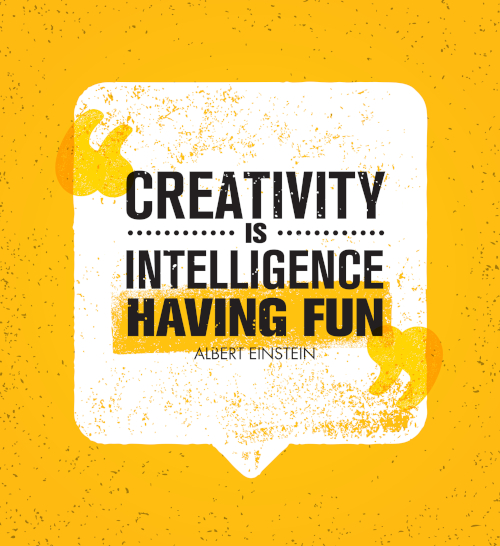 Einstein quote
ID 85927964 © Roman Doroshenko | Dreamstime.com
Einstein quote
ID 85927964 © Roman Doroshenko | Dreamstime.comThe dynamic value of existence is creative in nature. It allows for the expression of all the different specific forms and behaviours found in the phenomenal worlds and is governed by a dynamic value of intelligence – creative intelligence, Prakriti.
As with Purusha, Prakriti operates on both the cosmic and individual levels of life. The supreme value of creative intelligence (Para-prakriti), the organising power of the entire cosmos, is both silent and yet full of infinite creative potential. From the perspective of silence, she is one with the cosmic value of Purusha. From the perspective of dynamism, she is the source of all the organising power in nature.
At the individual level, each life form has its own unique nature, reflected in the character of
individual values of creative intelligence which govern the behaviour of the individual.
Natural vs artificial intelligence
Intelligent behaviour has been observed in both natural systems (organisms or living things) and artificially constructed, computer-controlled machines (robots, smart assistants etc.). Thus, there are two different practical contexts for the use of the idea of intelligence: “natural intelligence” and “artificial intelligence”.
The meaning of natural intelligence
 Dolphin looking playful
ID 132870499 © Andrei Stancu | Dreamstime.com
Dolphin looking playful
ID 132870499 © Andrei Stancu | Dreamstime.com Natural intelligence is present in all the control systems found in Biology. It has been observed in humans, animals and plants, even in single-celled creatures such as amoeba. Also in swarms of creatures such as ants, bees, termites, even in large flocks of birds or schools of fish. We could sub-divide natural intelligence into categories, such as:
- Human intelligence
- Animal intelligence
- Plant intelligence
- General biological intelligence
- Social intelligence
Artificial intelligence (AI)
 Robots and man with laptop sitting in a line
ID 128868021 © Kiosea39 | Dreamstime.com
Robots and man with laptop sitting in a line
ID 128868021 © Kiosea39 | Dreamstime.com Artificial intelligence (AI) is designed by computer scientists and engineers to simulate aspects of human intelligence. AI is assisting humans in solving a variety of different kinds of problems. Some AI machines are for research purposes, some to help make things in factories (e.g. robots for making cars) and others to help with communications (translators, smart assistants) or domestic chores (household robots) or to play games such as chess. Robot swarms are simple and cheap to make and the behaviour of such a swarm can be surprisingly complex (see examples on You-tube).
Recent years have seen enormous developments in AI, especially in analysing vast amounts of data at great speeds for almost any purpose. AI assistants are rapidly becoming increasingly sophisticated and are able to search for data relevant to a problem, analyse it in ways that simulate human understanding and present conclusions that conform to human reasoning abilities. For some purposes involving mathematical or logical analysis, AI is already superior to human intelligence.
Human intelligence
There is a clear relationship between the cosmic and individual values of both administrative and creative intelligence. Human intelligence is capable, when properly cultured, of both appreciating and directly experiencing this most intimate connection on the level of human consciousness. Great sages throughout human history have taught that complete realisation of this profound truth is the highest form of human accomplishment, satisfying the very purpose of human life.
Psychological theories of human intelligence
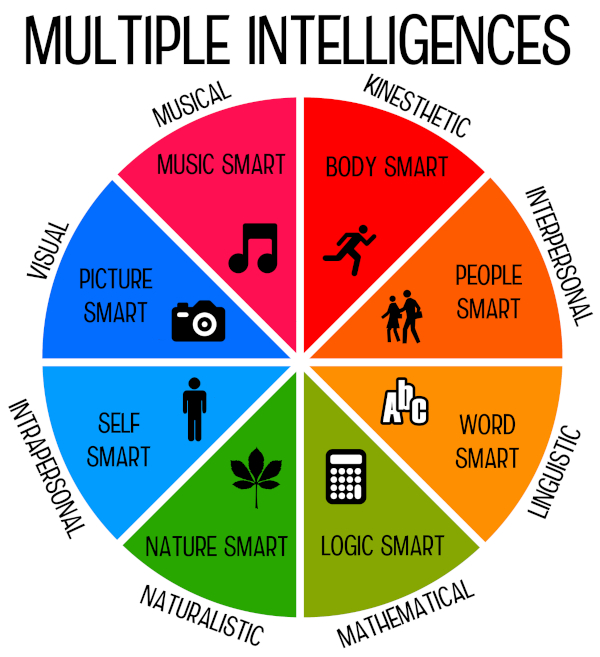 Multiple intelligences graphic
ID 47893488 © Alain Lacroix | Dreamstime.com
Multiple intelligences graphic
ID 47893488 © Alain Lacroix | Dreamstime.comPsychologists have proposed various ways to understand the meaning of intelligence over the last century and a half, starting with the key idea that intelligence is what helps humans to learn, to solve problems and to adapt to new situations. Although there are several useful approaches, there does not seem to be a single accepted theory which covers all aspects of intelligence adequately.
The ideas investigated range from notions of general intelligence – a single general characteristic lying behind several different kinds of problem-solving ability (Spearman, Thurman) to theories of multiple different and specific forms of intelligence which operate within their own specific contexts (Gardiner). There are other categorisations as well such as Sternbergs triarchic theory involving three different aspects of general intelligence which interact in any given set of circumstances, or the notion of fluid and crystalline intelligence put forward earlier by Cattell. In addition other kinds of intelligence such as emotional intelligence have been identified and analysed (Mayer, Caruso, & Salovey).
In each case, psychologists try to come up with measures, such as IQ score for general intelligence, that enable the different aspects of intelligence to be observed, measured and compared - and from there to determine the factors affecting their development.
Social intelligence
Many individuals of a given species can often live together in a coherently functioning society, such that each individual plays a part in the life of the whole. In that case, the society as a whole can be considered to function in some respects as an intelligent entity in its own right and we can consider, in the case of natural intelligence, the existence of a collective value of consciousness, with its own separate and unique identity.
Key Takeaways
- the meaning of Intelligence is shown in the power of consciousness to know, to experience and to create
- Intelligence governs behaviour, so that the purpose of life can be fulfilled
- Intelligence operates on both a cosmic level and on the level of the individual.
- On the cosmic level, the laws of nature govern the way the universe behaves including the consequences of individual behaviour and the evolution of life.
- Intelligence has both silent and dynamic states. Silence governs the self, dynamism governs experience, knowledge and creativity.
Links to more information
How to improve your own intelligence to create more meaning.
How to gain the support of the intelligence of nature for the success of your own endeavours.
Author Bio

Jeremy J Bowler MSC, DSCI, is a Transcendental Meditation teacher and author who writes about the meaning of life through Maharishi’s Vedic wisdom. He has studied Maharishi’s teachings for over 50 years, taught TM since 1973, and supported many hundreds of people through personal instruction and on meditation and residential courses. Jeremy is the author of The Sage and the Lotus, published on Amazon and Smashwords. He still values his own twice-daily TM practice, which has helped him find deep meaning in his own life, even through difficult times.
For a fuller description, see here.